
 Ninchanese
Yocha is live. Our Chinese grammar app has a new name, a new design, a bigger practice system, and, for the first time, an iPhone version. It is still built around one stubborn idea: Chinese grammar should not feel like a wall.
Get Yocha free on iPhone & Android
Some rules look harmless until they start moving around inside real sentences. 了 is not just “past tense.” 把 is not just a weird word order someone invented to ruin your evening. 的, 地, and 得 are not three ways to make your day worse, even if they do seem committed to the role.
Yocha exists for that exact moment: when you need the rule to click.
What is Yocha? A Chinese grammar app for iPhone and Android
Yocha is our focused Chinese grammar coach. It grew out of the AI Chinese grammar tool many of you already used, same mission, much sharper.
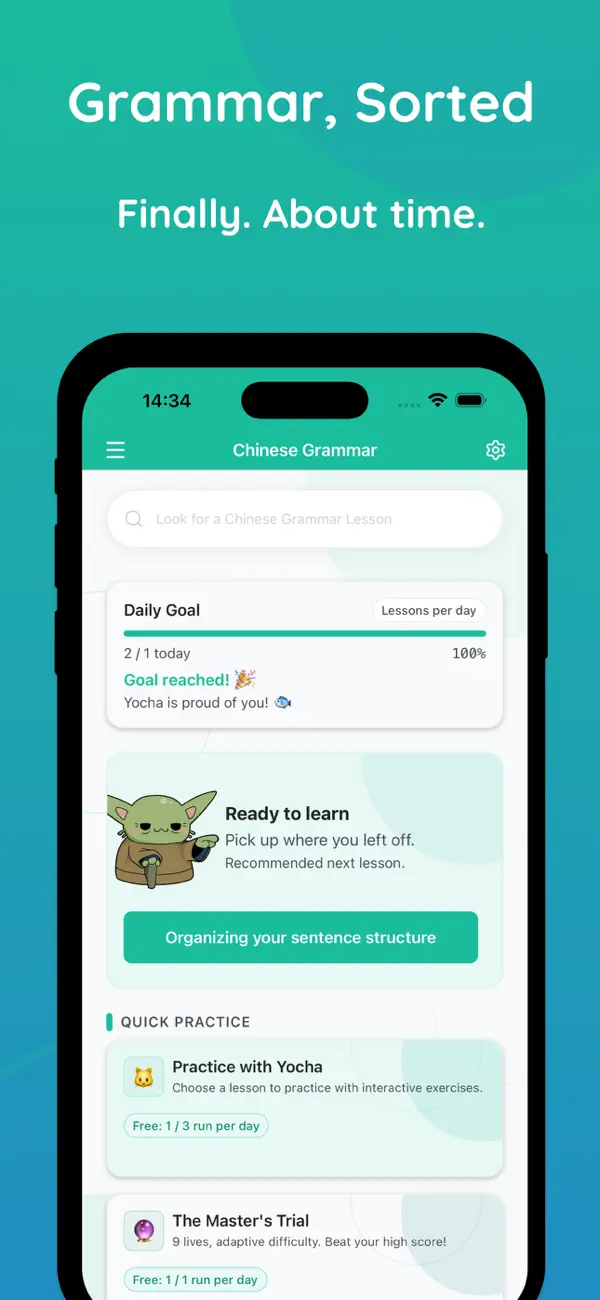
Inside the app you get:
- 140+ grammar lessons, from beginner to advanced
- Clear examples pulled from real Chinese, not textbook robots
- HSK 1 to 5 grammar topics, organized so you can follow your level
- Quick practice right after the explanation, while it is still fresh
The lessons stay free to read. That part matters. You can open the app, look up a grammar point, read the explanation, and keep learning, without being pushed into payment before anything has actually made sense.
Yocha Pro is for learners who want more practice volume: unlimited drills, unlimited Master’s Trial runs, more saves in The Gym, review tools, and premium Mandarin audio. It is a one-time purchase, not a subscription. Buy it once, keep it.
Grammar that finally clicks (a quick taste)
Here is the kind of thing Yocha is built to untangle.
了 vs 过. Both can look like “the past,” but they answer different questions. 我去过北京 (wǒ qùguo Běijīng) means “I have been to Beijing,” it is about experience, a thing you have done at some point. 我去了北京 (wǒ qùle Běijīng) is about a completed action in context: “I went to Beijing.” Same trip, different point. Yocha shows you which question you are actually answering.
把 (the bǎ sentence). It feels backwards because it moves the object forward so you can say what happened to it. 我把门关了 (wǒ bǎ mén guān le) means “I closed the door,” but with the focus on the door and the result. Once you see it as “take this object and do something to it,” the wall turns into a door. That you can close.
Multiply that by 140+ lessons, and you start to see the point.
Why iPhone matters
Chinese grammar has lived on Android for a long time. This release brings Yocha to iPhone too, which means more learners can reach the same grammar library on the phone they already study with.
For a grammar app, that is the whole game. You do not always need a full desktop session. Sometimes you just need to check why a sentence uses 过 instead of 了 while your tea is still warm.
That is the job.
How Yocha and Ninchanese work together
Yocha helps you understand. Ninchanese helps you practice until it sticks.
Those are two different moments in learning Chinese. When a grammar point is fuzzy, open Yocha: read the lesson, look at the examples, try the quick practice. When the rule starts to hold together, go back to Ninchanese and drill it inside a broader learning path.
You can use either one on its own. But the loop is stronger together:
- Understand the grammar in Yocha.
- Practice it in Ninchanese.
- Come back when the rule gets fuzzy again.
That is the ecosystem we are building: not another pile of exercises, but a cleaner path from “I sort of get it” to “I can actually use it.”
A small launch gift
To celebrate the launch, we also made a Ninchanese coupon. Use the code YOCHAGRAMMAR for 30% off all Ninchanese plans, new plans and upgrades included. The code is valid until June 26, 2026.
Because Yocha can explain the grammar, yes. But Ninchanese is still where the reps happen. A cat can only do so much before it needs a nap.
Get Yocha
Download Yocha here: ninchanese.com/yocha-chinese-grammar-app
The page has both App Store and Google Play links, plus a short FAQ about free lessons, Yocha Pro, and how the app fits with Ninchanese.
If a specific lesson helps a grammar point finally click, tell us. Those replies are genuinely useful. They tell us which explanations are doing their job, and which ones still need a sharper claw.
P.S. App Store and Google Play reviews help a lot right now. If Yocha helps you, a short review is one of the most useful things you can do for the app.
Frequently asked questions
Is Yocha free?
Yes. All 140+ grammar lessons are free to read. Yocha Pro is an optional upgrade for more practice volume and premium audio.
Is Yocha Pro a subscription?
No. Yocha Pro is a one-time purchase. You pay once and keep it.
Is Yocha on iPhone and Android?
Both. Yocha is now available on the App Store (iPhone) and Google Play (Android). Grab it from the Yocha app page.
Does Yocha cover HSK grammar?
Yes. Yocha covers grammar topics across HSK levels 1 to 5, organized so you can follow along at your level.
What is the difference between Yocha and Ninchanese?
Yocha helps you understand a grammar rule. Ninchanese helps you practice it until it sticks. Use Yocha when a point is fuzzy, then drill it in Ninchanese inside a full learning path.