
 Ninchanese
Numbers are everywhere and when learning Chinese you will very soon get to know the basic numbers and count using Chinese. Right after that, there’s the big numbers, you will count even higher: at first up to 100 (一百), then 1000 (一千) and finally 10000 (一万). These are the basics to know, but what if you want to use the really big numbers and the amount of zeros is getting out of control? Find it out how by continuing reading.
So, when it comes to counting and juggling with numbers in Chinese, it normally is not that hard as long as the numbers do not go too big. Big numbers are a bit different.
Too big in this case means, let’s say, above 100.000. I think, up to that, everything is still okay. However, even after that, there’s a system behind it, which seems logical as soon as you are familiar with it.

For me, it took quite a long time to understand the logic behind Chinese numbers. Because first, it never occurred to me that I may need this knowledge and therefore wasn’t that interested in it.
Second, in typical Chinese classes or workbooks, the system is never explained properly.
You only get to learn the characters with a simple “it is as it is” because to be honest, the numbers you are mostly using when learning Chinese are Time, Age, Phone numbers, Prices, Measuring, all part of the daily life. So, let’s start simple and take a look at the base numbers:
| 1 | 2 | 3 | 4 | 5 | 6 | 7 | 8 | 9 | 0 |
| 一 | 二 | 三 | 四 | 五 | 六 | 七 | 八 | 九 | 〇 |
| yī | èr | sān | sì | wǔ | liù | qī | bā | jiǔ | líng |
This table is the basic simplified way of expressing numbers. Beware, there are already a few specialties which I want to mention:
The number 1 – yī or yao?
Sometimes the number 1 一 is pronounced “yao” instead of “yi.”
That is the case when the number you are reading aloud has no mathematical meaning, like Phone numbers, ZipCodes, etc. It’s just for combinations of numbers without any deeper meaning, and it makes it more understandable when listening because 1 yī and 7 qī can be confused. But as soon as the number 1 is part of a sequence or an order, it’s pronounced yī — for example, bus numbers, floor numbers, month, age, etc.
The number 2 – èr or liǎng?
Similar to number 1, there are cases when the 2 changes and becomes liang 两. It’s a bit different because it’s an entirely different word but also expresses two.
二 only can express an ordinal number like in February (二月 second month), 第二 …
The only exception is the time. You also can say 两点钟. 两 can only be used as numeral e.g., 两天 and is generally used in front of a classifier/measure word e.g. 两只猫,两张桌子
When you want to express an approximate amount by using two-three, you should use 两三, but only when the expressed amount is lower than 10. (e.g., I went there 2-3 times / 我去过那里两三次). When the approximate amount is bigger than 20 it becomes 二三 (e.g., Last year I traveled 20.000 -30.000 kilometers / 去年我旅行了二三万公里) .
The number 0 – 〇 or 零 ?
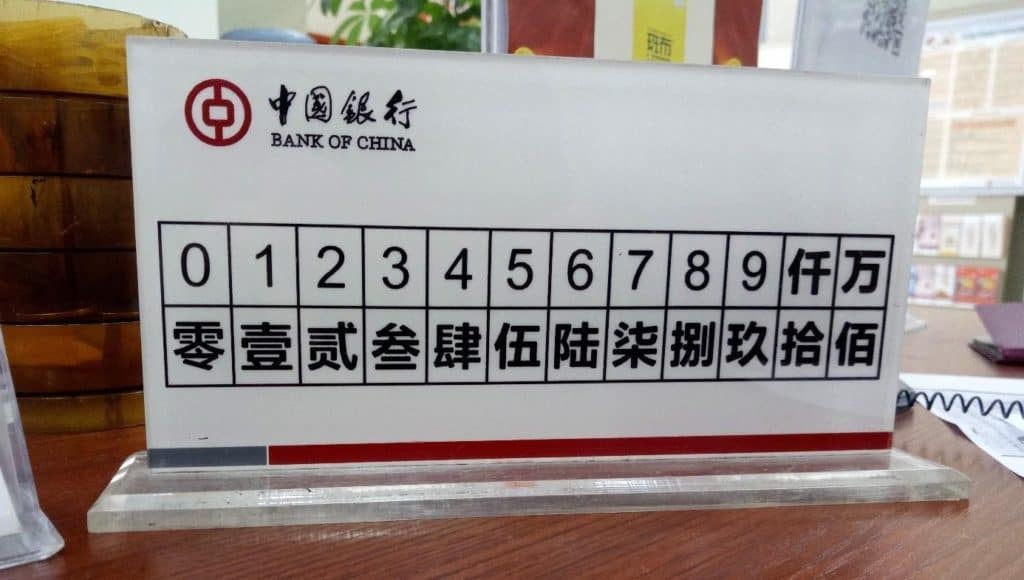
The numbers in the table are straight forward, easy to learn and be remembered, but you may wonder why I wrote the 〇 and not the 零 for the zero. The reason is that technically the round circle is the simplified version of the 0, and the 零 you may be familiar with is already the complex (not to confound with traditional) version. 零 is used by banks to make written numbers on bank checks safer, more resistant to fraud, and to avoid mistakes.
These complex forms exist for all the base numbers and even for the characters to do the steps of ten, hundred and thousand. The picture should be obvious which character is which number. The last 4 fields are the zero-characters:
Although the characters are different, the pinyin stays the same. The next paragraph will show some cases where the pinyin also changes a bit.

Number colloquialism
A bit rarer known is the fact that the basic Chinese numbers can sound different, and the characters can be altered with a radical to express the amount of something. In this case, the number is like already merged with a measure word, so you cannot use another one behind it.
These are more like predefined, so you can’t just add everything together you have in mind, and some of these characters also have more meanings than just the number.
Below are some examples. I think the most commonly known one among Chinese learners is the 俩 – 我俩= Both of us (我们俩 – adding a 们 is more used in written language). Be aware that there’s also this character: 仁 (rén), which logically may fit into the slot for the number two, but keeping the rule for the number 2 mentioned above in mind, this character actually has no numerical meaning so instead it is 俩.
| No | Amount | Merged | Pinyin | Example | Example Translation |
| 2 | 两个人 | 俩 | liǎ | 我俩 | Both of us |
| 3 | 三个人 | 仨 | sā | 我仨 | Three of us |
| 4 | 四个人 | 伵 | sì | 我伵 | Four of us |
| 4 | 四匹马 | 驷 | sì | 驷 | (A team of) four horses |
| 5 | 五个人 | 伍 | wǔ | 我伍 | Five of us |
| 8 | 八个人 | 仈 | bā | 我仈 | Eight of us |
| 9 | 九个人 | 仇 | qiú | 我仇 | Nine of us |
| 10 | 十个人 | 什 | shí | 我什 | Ten of us |
Getting to the big numbers in Chinese
After the basics are settled, let’s take a look at the bigger numbers and the zeros:
From a Westerners’ point of view, the zeros are packed up by thousands, so when a new 1000-package starts, we will get a new word to describe it. As simple as it sounds, looking at the Chinese translation, it seems quite confusing what’s going on there. That’s because, in Chinese, they pack the zeros into ten-thousands so that they will use a new word after every 4 zeros. It’s important to know to understand the Chinese big numbers.
Note: For the naming of these big numbers, I’m using the Short scale naming, which is also used in the US. This scale doesn’t include the words Milliard and Billiard and, therefore, continues with the next word in the row.
| Number | English short scale name | Chinese |
| 0 | Zero | 〇 Líng |
| 0 | Ten | 十 Shí |
| 100 | One-Hundred | 一百 Yī bǎi |
| 1000 | One-Thousand | 一千 Yī qiān |
| 10.000 | Ten-Thousand | 一万 Yī wàn |
| 100.000 | One-Hundred-Thousand | 十万 Shí wàn |
| 1.000.000 | One Million | 一百万 Yī bǎi wàn |
| 10^7 | Ten Million | 一千万 Yī Qiān wàn |
| 10^8 | One-Hundred Million | 一亿 Yì |
| 10^9 | One Billion | 十亿 Shí Yì |
| 10^10 | Ten Billion | 一百亿 Yī bǎi Yì |
| 10^11 | One-Hundred Billion | 一千亿 Yī Qiān yì |
| 10^12 | One Trillion | 一兆 Yī zhào |
| 10^13 | Ten Trillion | 十兆 Shí zhào |
| 10^14 | One-hundred Trillion | 一百兆 Yī bǎi zhào |
| 10^15 | Quadrillion | 一千兆 Yī Qiān zhào |
| 10^18 | Quintillion | 一百京 Yī bǎi jīng |
| 10^21 | Sextillion | 十垓 Shí gāi |
Rearranging the big numbers using the Chinese 4-zero-system, it will look like this:
For a better understanding of the logic behind the big numbers in Chinese, the Chinese and pinyin columns are aligned right.
| Number | English short-scale name | Chinese | Literal Translation |
| 0 | Zero | 〇 Líng | Zero |
| 10 | Ten | 十 shí | Ten |
| 100 | One-Hundred | 一百 Yī bǎi | One-Hundred |
| 1000 | One-Thousand | 一千 Yī qiān | One-Thousand |
| 10000 | Ten-Thousand | 一万 Yī wàn | Ten-Thousand |
| 10.0000 | One-Hundred-Thousand | 十万 Shí wàn | Ten Ten-Thousand |
| 100.0000 | One Million | 一百万 Yī bǎi wàn | One-Hundred Ten-thousand |
| 10^7 | Ten Million | 一千万 Yī Qiān wàn | One-Thousand Ten-thousand |
| 10^8 | One-Hundred Million | 一亿 Yī Yì | One Yi* |
| 10^9 | One Billion | 十亿 Shí Yì | Ten Yi* |
| 10^10 | Ten Billion | 一百亿 Yī bǎi Yì | One-Hundred Yi* |
| 10^11 | One-Hundred Billion | 一千亿 Yī Qiān yì | One-Thousand Yi* |
| 10^12 | One Trillion | 一兆 Yī zhào | One Trillion** |
| 10^13 | Ten Trillion | 十兆 Shí zhào | Ten Trillion** |
| 10^14 | One-Hundred Trillion | 一百兆 Yī bǎi zhào | One-Hundred Trillion** |
| 10^15 | One Quadrillion | 一千兆 Yī Qiān zhào | One-Thousand Trillion** |
| 10^16 | Ten Quadrillion | 一京 Yī jīng | One Jing* |
| 10^20 | One-Hundred Quintillion | 一垓 Yī gāi | One Gai* |
| 10^24 | Septillion | 一秭 Yī zǐ | One Septillion** |
*There are no single words to directly translate a 1 with 8 (or 16, 20 etc.) zeros without already adding a ten or one-hundred which I think would not describe the character correctly then. In general, the rows continue with a new word, then adding a 10, 100, 1000 before a next new word appears.
**When the number of zeroes is divisible by 3 and 4 (10^12, 10^24), the Chinese character becomes the direct equivalent of the western name.
Besides their numeric value, these Chinese characters can also be used to express an undefined quantity:
| Character | Pinyin | Decimal | Short scale name | Alternative meaning |
| 十 | shí | 10^1 | Ten | complete, full, perfect |
| 百 | bǎi | 10^2 | Hundred | many, numerous, all kinds of |
| 千 | qiān | 10^3 | Thousand | many, numerous, a great amount/number of |
| 万 | wàn | 10^4 | Ten-Thousand | Innumerable, myriad, a very great number of |
| 亿 | Yì | 10^8 | One-Hundred Million | many |
| 兆 | zhào | 10^12 | One Trillion | mega- (long scale) or tera- (short scale) |
| 京 | jīng | 10^16 | Ten Quadrillion | big, a large number |
| 垓 | gāi | 10^20 | One-Hundred Quadrillion | – |
| 秭 | zǐ | 10^24 | Septillion | – |
There are more usages of these characters, and the archaic quantities of those numbers were different, but this would be a different topic on its own.
Final words about big Chinese numbers
No worries if all these zeros and the large numbers confused you. In daily conversations, you rarely use those. Can you recall when the last time was you talked with someone about those quantities, even in your mother tongue? It’s just nice to know these words when you read these, and mostly it’s just to express a massive amount of something instead of an accurate number.
The most important thing to know is the split by 4, which for me was really an eye-opener when I learned that. It also helps to remember the number attached to the characters (also the attentive learner will recognize that the more strokes a big number-character has, the more zeros it has)
Stefan and The Nincha Team
1 comment
Join the conversationCovid - April 18, 2020
Did you know? Because the Chinese characters for numbers are very simple, there is a whole different set of complex Chinese numbers used on bank notes to prevent counterfeit bills.
Comments are closed.